The first loss is not a trading problem. It is a state-change problem.
The common mistake is treating the symptom as the problem. The DTR standard is to find the behavior, name the trigger, write the rule, and test it under live account pressure. Kahneman and Tversky showed that losses hit behavior harder than equivalent gains. Steenbarger and Tendler both point to the same practical truth: performance improves when behavior is observed, scored, and corrected. Jared Tendler's mental-game work points to the same standard: name the pattern before it hijacks the next decision.
Loss-recovery decision tree
The first loss is not the account killer. The next decision is. The map below shows the moment we are trying to interrupt before it becomes a revenge sequence, stop negotiation, or freeze response.
Red trade prints
Do not explain it yet. Tag it first.
Decision quality danger zone
No new trade until state is named.
Recovery or review
Trade only if the setup stands alone.
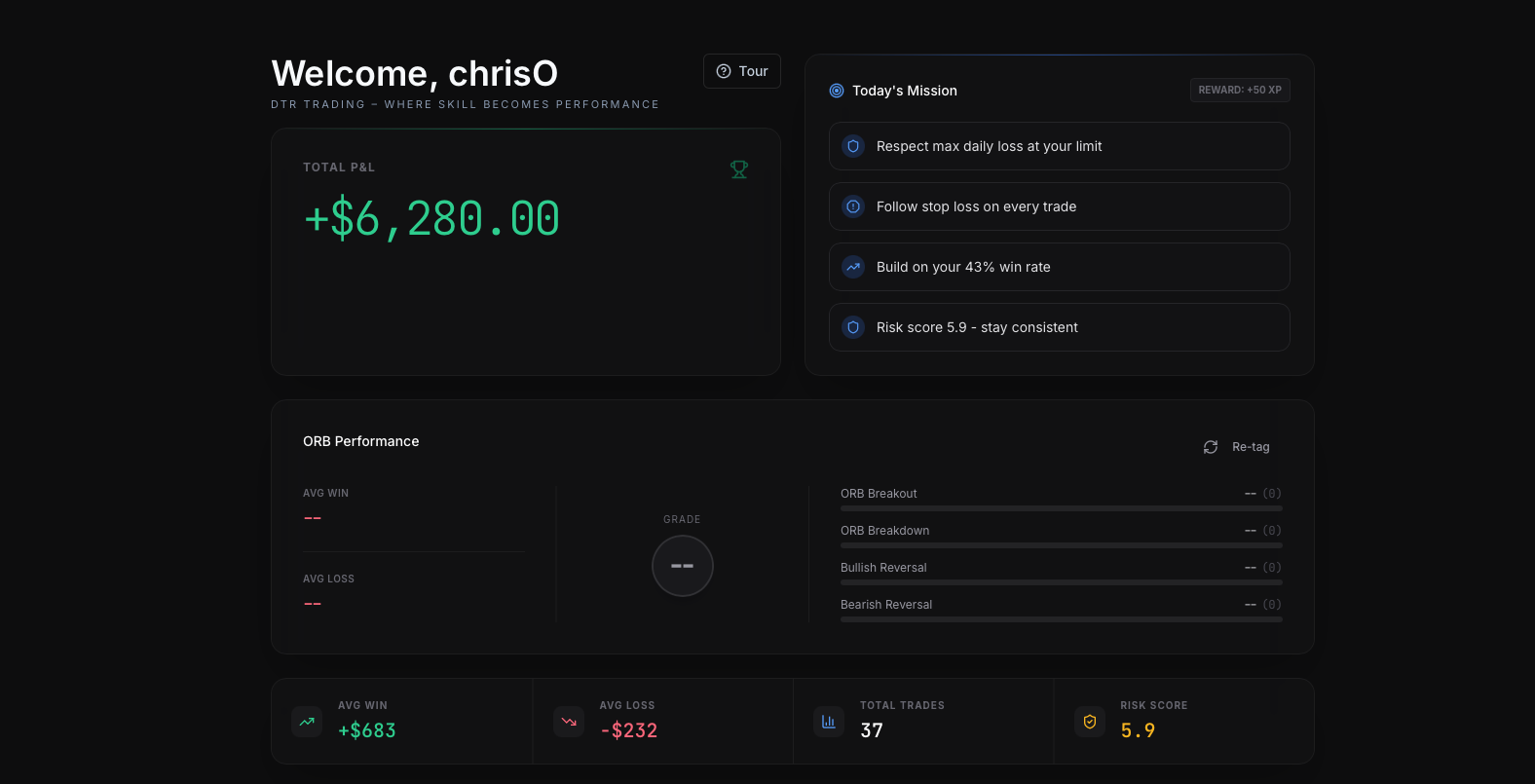
Trader dashboard proof: process metrics, P&L, mission rules, and risk score in one view.
The coaching environment matters because the dangerous trade happens in real time. Static advice cannot interrupt a live state change.
Score Your Last Loss Recovery
Answer against your most recent account, not the ideal version of your trading. This only works if the evidence is honest.
Question 1
What was the first thing you did after your last red trade?
Answer from the last real red trade, not from the trader you wish you were.
Why the first loss matters more than the first trade
Before the first loss, most traders can pretend they have discipline. After the first loss, the account reveals the real operating system.
The dangerous question is not 'Can I find another setup?' It is 'Am I trying to make the account feel whole again?'
This protocol interrupts the emotional state before it becomes a revenge sequence.
The trader who can take the first loss cleanly gets to keep thinking. The trader who cannot starts negotiating with the account.
The four-step protocol
Pause before explaining. Write one sentence: did I follow my plan, yes or no?
Tag the loss type: good planned loss, bad setup, late entry, oversized risk, stop moved, revenge entry, emotional exit, or hesitation rule break.
Decide if you are still allowed to trade. If the next trade only looks good because you are red, you are done.
Write the next-trade rule before another entry: valid setup, calm risk, defined stop, no revenge.
The account-protection rule
A good planned loss permits continuation. A rule-break loss moves you to review mode.
The protocol is not there to make you feel better. It is there to stop one loss from recruiting the next three.
Worked example
A trader loses on a planned long. Instead of immediately shorting because price dropped, they tag it: good planned loss.
Heart rate is calm, risk was respected, and the next setup is independent. They may continue.
If the loss had included a moved stop or oversized risk, the session would end even if another setup appeared.
Operating note
A brief only matters if it changes the next decision under pressure.
Keep this document close enough to use before the trade, not after the damage is already visible in the account.
The standard is simple: fewer explanations, cleaner rules, and written evidence that your behavior is becoming more repeatable.
Choose the coached evaluation that matches your discipline.
Coached evals are for traders who want structure around the process. You get the evaluation account, live DTR access tied to the coached eval, and one free reset if the first attempt does not click.
Starter
50K
$369
$221
40% off
automatically applied at checkout
- $3,000 target
- $2,000 max drawdown
- Live coached access
Most popular
100K
$569
$341
40% off
automatically applied at checkout
- $6,000 target
- $3,000 max drawdown
- Best process-to-cap fit
Serious cap
150K
$769
$461
40% off
automatically applied at checkout
- $9,000 target
- $4,500 max drawdown
- For controlled sizing
FAQ
Is this a strategy?
No. It is an operating document for the behavior that decides whether a prop account survives.
Why does this matter for prop accounts?
Because the account usually fails when the trader changes size, timing, stop logic, or review behavior under pressure.
Should I buy another evaluation if I score poorly?
Only if the score produces a rule first. A new login does not fix the same reaction pattern.
Why DTF instead of a cheaper eval?
Because the coached path gives you an account plus a process environment: live trading, rules, review, and a reset structure.